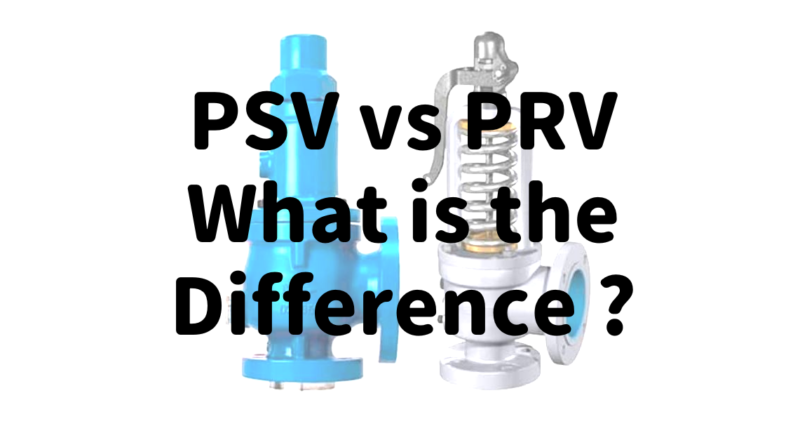
In this article, we will explain the differences between a Pressure Safety Valve (PSV) and a Pressure Relief Valve (PRV).
Often, both are collectively referred to as "safety valves" because their fundamental purpose—releasing pressure from within a system—is the same. However, depending on the design philosophy of the manufacturer or engineering company, they are sometimes clearly distinguished.
In such cases, they may even be assigned different symbols or tag numbers on a P&ID (Piping and Instrumentation Diagram).
When they are distinguished, the difference lies primarily in their installation purpose and valve operation. From the next section onward, we will dive into what exactly sets a "Safety Valve" apart from a "Relief Valve."
You May Also Like
Installation Purpose
Pressure Safety Valve (PSV)
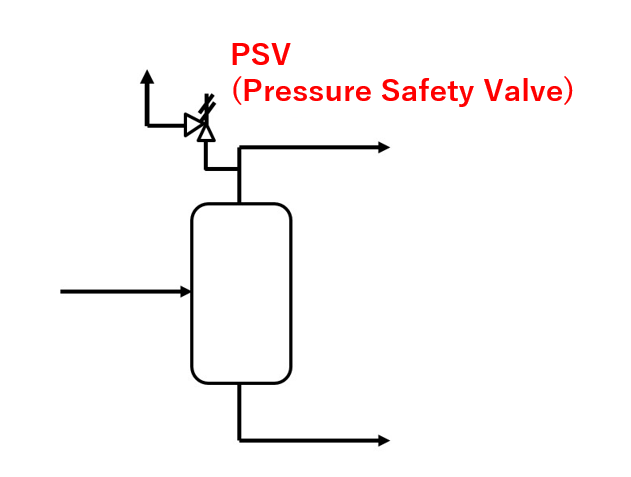
The primary purpose of a safety valve is to "prevent equipment damage, as well as human and environmental harm caused by a pressure rise."
In other words, it acts as a safety device (the final stronghold) to prevent accidents that could occur in a plant.
It is especially used for compressible fluids like gases. Since overpressurization in gas systems can lead to explosions with catastrophic human and environmental consequences, the pressure relief device installed on such equipment and piping is specifically called a "Safety Valve."
Because a safety valve is designed to operate during abnormal plant conditions, it is not expected to actuate during normal operations. Additionally, the discharge (secondary side) of a safety valve is usually routed to the atmosphere or a flare system.
Pressure Relief Valve (PRV)
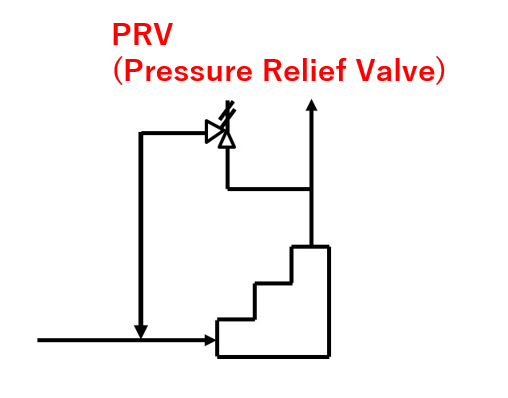
On the other hand, the primary purpose of a relief valve is to "limit the system pressure within a predetermined range." While it shares the goal of preventing pressure-related accidents and troubles, its role is more focused on pressure control to ensure stable plant operation, distinguishing it from a pure safety device.
Relief valves are mainly applied to liquids (incompressible fluids). For instance, the pressure relief device installed on the discharge side of a reciprocating pump is typically called a "Relief Valve."
Because its main goal is pressure control, it is entirely possible for a relief valve to operate during normal plant operations. (It might be helpful to think of it as similar to the spillback control of a reciprocating compressor.) Also, like the relief valves on reciprocating pumps, the discharge is often routed back into the process piping.
Valve Operation
Pressure Safety Valve (PSV)
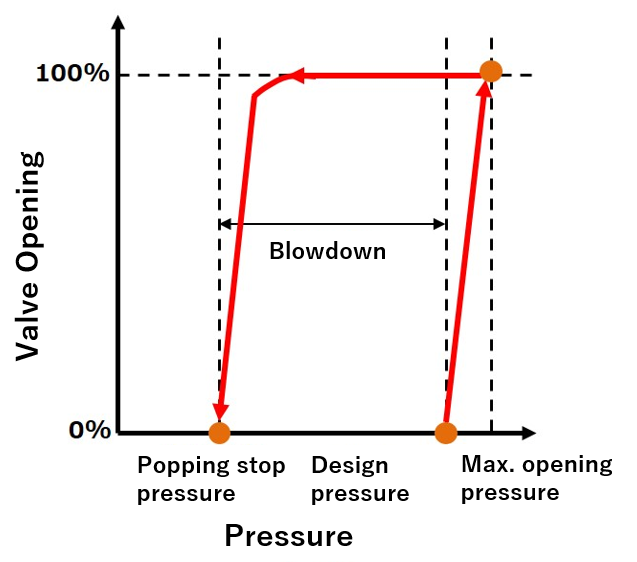
Since its primary objective is to act as a safety device, a safety valve must rapidly depressurize the system. Therefore, it is designed to pop fully open immediately upon reaching the set pressure. (Note: In practice, there is an "accumulation" of pressure from the set pressure until it reaches the maximum relieving pressure.) Due to this pop-action characteristic, the pressure difference between the point where it starts relieving and the point where it fully closes (blowdown) is relatively large compared to a relief valve.
Pressure Relief Valve (PRV)
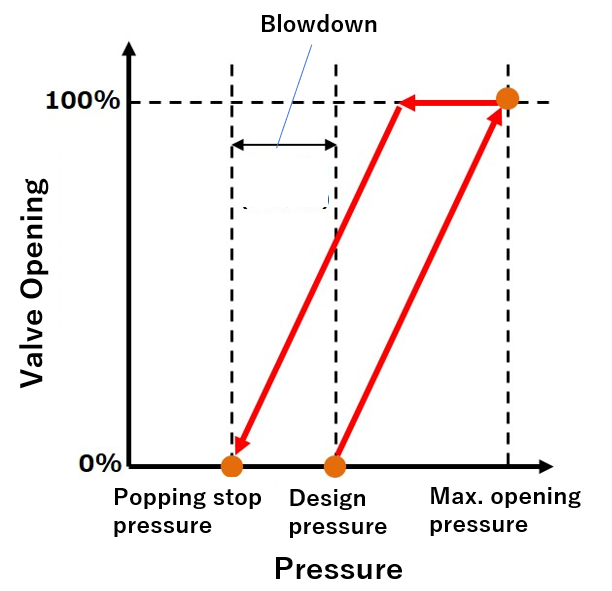
Since its main purpose is pressure control, a relief valve does not pop fully open immediately upon reaching the set pressure. Instead, its opening degree increases proportionally as the pressure rises. (The operation is somewhat similar to that of a control valve.) Similarly, as the system pressure drops due to the fluid discharge, the valve opening decreases proportionally until it fully closes at the reseating pressure. Because of these proportional characteristics, the difference between the set pressure and the reseating pressure (blowdown) is smaller than that of a safety valve. Depending on the type of relief valve, operators may also be able to manually adjust the valve opening.
Conclusion
In this article, we explained the differences between Pressure Safety Valves and Pressure Relief Valves. Although their core goal of releasing system pressure is the same—leading many to refer to both simply as "safety valves"—manufacturers and engineering firms often distinguish between them based on their specific philosophies.
When a distinction is made, it is based on their installation purpose and operational characteristics, which can also result in different symbols and tag numbers being used on a P&ID.
