
In this article, the concept of bonding in process piping is explained from the standpoint of static electricity control.
Inside a pipeline, fluid is continuously flowing. Due to friction between the fluid and the pipe wall, electric charge is transferred, and the fluid becomes electrostatically charged (flow electrification).
When a section of piping becomes electrically isolated—for example, by a flange gasket made of a non‑conductive material—the accumulated charge cannot dissipate and continues to build up. Under such conditions, a static discharge may occur from the piping, creating an ignition source.
For plants handling flammable fluids, this phenomenon presents a credible fire and explosion hazard.
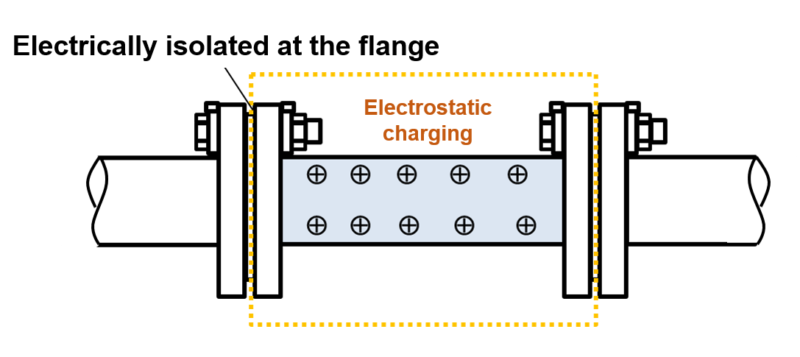
Low‑conductivity liquids (conductivity ≤ 10⁻⁸ S/m) are particularly prone to flow electrification, and the risk is highest around 10⁻¹¹ S/m. Petroleum products such as gasoline and kerosene fall into this category and therefore require strict countermeasures.
In addition, when Teflon (PTFE) gaskets are used at flanged joints, the gasket acts as an electrical insulator. This increases the likelihood that the piping upstream and downstream of the flange will become electrically isolated, further elevating the risk of charge accumulation.
To mitigate these hazards, bonding is implemented.
You May Also Like
What Is Bonding?
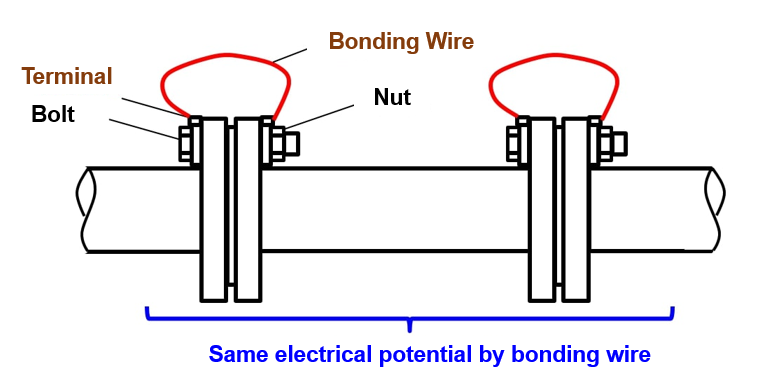
Bonding is a static electricity mitigation measure in which adjacent piping sections (e.g., across a flange) are electrically connected using a conductor such as a bonding wire or metal plate.
By eliminating the potential difference between the two piping sections, accumulated charge is safely dissipated, preventing electrostatic discharge.
In process plants handling flammable fluids, bonding is considered an essential safety measure.
Therefore, during piping design, bonding must be incorporated without omission.
Fluids Requiring Bonding
Considering the potential for static‑induced ignition, bonding is required for piping that handles flammable fluids, including:
- Natural gas
- Fuel oils
- Aromatics
- Methanol
- Gasoline
- Other petroleum products
Flow electrification is most severe in fluids with conductivity ≤ 10⁻⁸ S/m, and particularly around 10⁻¹¹ S/m.
Petroleum products fall within this range and therefore require mandatory bonding.
Bonding Wire Requirements
Bonding wires must:
- Be made of corrosion‑resistant materials
- Possess sufficient mechanical strength to avoid breakage during normal operation
- Maintain electrical continuity at all times
The electrical resistance of a bonding wire must be ≤ 1000 Ω.
Ordinary metallic wires or plates generally satisfy this requirement, but designers should remain aware of this criterion.
Bonding Terminals
Bonding terminals must be constructed of materials that are:
- Resistant to corrosion
- Mechanically robust
- Capable of maintaining reliable electrical contact
Connections are typically secured using compression terminals and bolts to ensure both electrical and mechanical integrity.
Points Requiring Attention
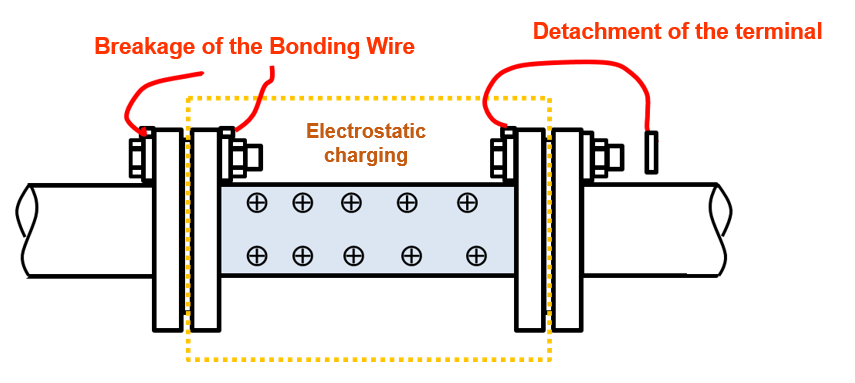
The most critical concerns in bonding implementation are:
- Breakage or detachment of bonding wires
- Poor electrical contact due to corrosion or loose connections
- Omission of bonding during installation
Additionally, installing insulating spools or hoses in the piping route creates the same condition as a broken bonding wire—electrical isolation—so such configurations must be avoided unless specifically engineered.
Regular inspection and maintenance are also essential.
Daily visual checks of bonding locations and periodic measurement of electrostatic potential are effective practices.
Summary
This article explained the fundamentals of bonding in process piping.
When piping becomes electrically isolated—for example, due to a non‑conductive flange gasket—the fluid inside the pipe can become electrostatically charged (flow electrification).
If this condition is left unmitigated, charge accumulation may lead to static discharge from the piping, creating an ignition source and potentially causing a fire or explosion.
Bonding eliminates potential differences between adjacent piping sections by electrically connecting them with a conductor, thereby preventing static buildup.
For piping systems handling flammable fluids, bonding is a mandatory safety measure and must be incorporated into piping design without exception.
